
Peugeot J7
| Manufacturer | Peugeot |
|---|---|
| Years of production | 1965 to 1980 |
| Production | 336 220 copy |
| Class | Commercial vehicle |
| Motor (s) | 4-cylinder in-line petrol and diesel |
| Displacement | Petrol: 1 468, 1 618 and 1 796 cc Diesel: 1 948, 2 112 and 2 304 cc |
| Maximum power | Petrol: 52 to 65 hp - Diesel: 48 to 66,5 hp |
| Maximum torque | Essence: 104 to 131 Nm |
| Transmission | Front-wheel Drive |
| Unloaded weight | 1800 kg |
| Maximum speed | 100 km / h |
| Bodywork | Van (from 8.7 m ), minibuses, pick-ups, livestock and chassis cab |
| Length | 4,740 mm |
| Width | 2000 mm |
| Height | 2,350 mm |
| wheelbase | 2500 mm |
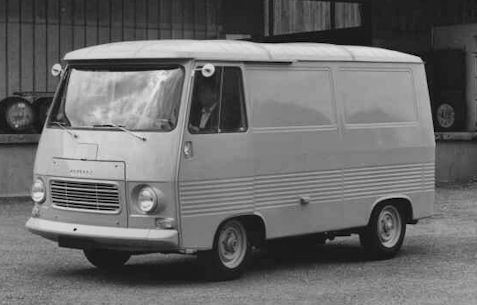
The J7 is a van sold by Peugeot as from June 1965 . It is manufactured at Chausson as the previous van D4B and, in small series, at Heuliez . The J 7 and J 9 were front-mounted pickup truck from Peugeot with front engine and front-wheel drive . This construction made possible, in addition to the usual panel van , station wagon and pick-up variants from the factory various other structures such. B. ambulance including chassis extensions of various bodywork companies .
The Peugeot J7 is a fairly compact pickup truck of advanced cabin type, with the engine under hood. It exists with petrol or diesel engines.The front-wheel drive of the J7 requires a more limited turning radius , but it allows a very low loading threshold further improved by the four-wheel independent suspension (no rigid rear axle like the current vans). The large volume for a van of these dimensions and the excellent reliability made the J7 the choice of many professionals at the time. The J7 has the particularity to have sliding cabin doors that allow rolling open doors.The principle Of "all forward" to the engine and transmission floor to 050 m from ground level,
Thus reducing effort to a minimum. The Open design Of the body provides interior: 4.6 m2 of flat floor. giving a capacity of 8.7 m: (10.1 m3 for the raised roof version). The height of the roof from floor is 1.83 m 2.13 m for raised roof version) The J7 will be available in Tahitian blue or pearl gray for 1400 kg and 1800 kg vans as well as emerald green or beige for the coach. The chassis and body have been designed using the performance techniques of aircraft construction. A rigid but light framework eminently suitable for all types Of conversion (lengthening. heightening, etc.). The side and cross members are of dimensions to withstand the points Of fatigue. The box sections are designed to withstand loading .
The J7 is first offered in a van of 1,400 kg payload. The first models can be recognized by their wheels in the same color as the body, with prominent conical front hubs and six round lights at the rear. The small front lights come from the 204 .During his career, the J7 is equipped with two basic engines, a gasoline engine with the Peugeot 404 and a Diesel ( Indenor ) whose displacement will evolve over time or according to the versions (J7 1,800 kg with a larger engine than the J7 1400 kg ).
The range is completed quickly by a 1,800 kg van (September 1965), a glazed van and a minibus (October 1965).Ambulances, livestock and the pickup arrive early 1966 .In September 1967 , the hatch access to the radiator cap disappears, we can now reach it by tilting the grille. A new dashboard with two round dials is emerging and a servo brake is now available as an option or as standard depending on the model.
With the J 9, the engines ranged from 1.6 to 2.4 liters, the power from 66 to 75 hp. The load compartment was the same size as the J 7, the total weight at the standard 1400 was 2.8 t, 1800 1800 t, at a curb weight depending on the type of a maximum of 1.7 t.
In September 1970 , the petrol versions went from 1.5 and 1.6 liter to 1.6 1.8 .For 1974 , the J7 adopts disc brakes at the front while the Comfort versions (minibuses, ambulances) see their special grille replaced by the same as the other models with an additional Lion.In September 1975 , a new straight dashboard with a four-spoke steering wheel from the 504 take place.For 1978 , the diesel versions of 1.9 and 2.1 liters go to 2.1 and 2.3 liters.At the end of 1980 , the Peugeot J7 was removed from the range. It is replaced by the J9 .
The J7 all versions (van, minibus, ambulance) will be produced from 1965 to 1980 to a total of 336 220 copies.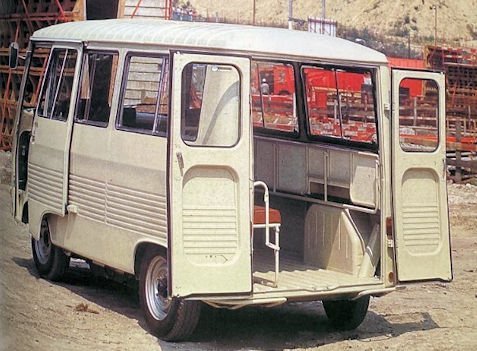
Related
Technical
-
Options
1) Raised roof.
2) Cab partition.
3) Front swing doors
4) Rear swing doors.
5) Two seater bench seat with inertia reel Seat belts
6) Power take-off.
Van 1,400 kgPetrol
- 1,468 cm 3 , 52 hp (8 hp )
- 1,618 cm 3 , 58 hp (8 hp ), from the 1971 models.
Diesel
- 1,948 cm 3 , 48 hp (7 hp )
- 2 112 cm 3 , 62 hp (7 hp ), from the 1978 models.
Van 1800 kg
Petrol
- 1 618 cm 3 , 58 hp (8 hp )
- 1796 cm 3 , 65 hp (9 hp ), from the 1971 models.
Diesel
- 2 112 cm 3 , 62 hp (7 hp )
- 2 304 cm 3 , 66.5 hp (8 hp and fourth elongated ratio), from 1978 models.
Note:
All engines and full specifications available for registered users© Motor-car.net

